Saturday, 29 April 2017
Blogging Against Disablism Day 2017
Sunday, 1 May 2016
Prejudice and Representation
Downloadable MP3
This blog post is a part of Blogging Against Disablism Day 2016. For more information and to read other work on the theme of disability descrimination, pride etc, see Diary of a Goldfish
Prejudice grows like mould; the smaller and darker the space, the worse the problem. In an insular group, everyone is an outsider. It's so much harder to treat anyone with bigotry when you're surrounded by a variety of voices, a variety of faces, a variety of hopes and dreams. So one of the key tools in fighting prejudice is to feed people with broad and positive representation in fiction, film and television.
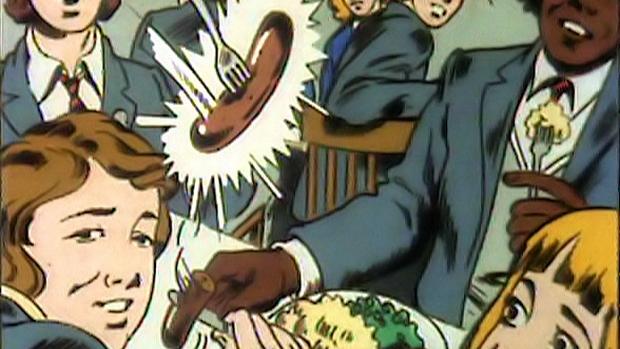
Thinking back to my own childhood, I remember very little about Grange Hill beyond the bullying which I recognised in my own school, and the character played by Francesca Martinez - the first person I saw with Cerebral Palsy. I remember, in extremely white Surrey, programmes like The Fresh Prince of Bel-Air and their broad cast of entirely individual people of colour. And I remember the bad, too - the disabled villains, stereotypical black men, and non-existant or entirely passive women of a hundred different programmes and films.
![]() |
| Grange Hill Theme |
--
In terms of narrative, it's obvious that, in the case of original stories like Grange Hill and The Fresh Prince, there are no barriers to inclusivity. If someone had wanted to write one of the Banks family as disabled, that would have been possible. However, there are also other situations in which people feel they have a genuine excuse for what amounts to disablist laziness.
Historical fiction is created with weight of fact to wrestle with. This is further complicated when the history is ancient as sources become uncertain or contradictory. In some ways this benefits the adapting author as they have numerous narrative options open to them. But those with privilege (or those brainwashed by the powers that be into thinking that things are as they are because that is how things *should* be) are restricted to the same old stories of Straight White Non-Disabled Men fighting their way to the top. These stories, damaging to our cultural health, are immensely boring. And, as Foz Meadows describes in this excellent post, it's missing something about what *really* happened in our history.
![]() |
| Richard the Third's death |
It is true that historical figures are often 'tainted' with a disablist brushstroke by critical contemporaries. But disablist caricatures only really work if we take those disabilities to be negative. If there wasn't an association between hunchbacks and evilness, Richard's disability would be neutral. There would have been no reason for historians to be sceptical about its reality, if it wasn't being used to cast him as a pantomime disabled villain.
We've recently watched a couple of historical TV series which have made choices to show disabled characters.
The Last Kingdom (adapted from the Bernard Cornwall novels) tells the story of a Saxon boy surfing the political and social waves of Britain during one of its biggest upheavals. In it we meet Alfred the Great (played by the great David Dawson). This Alfred, although viciously astute, is not a well man. There is significant historical evidence charting the course of Alfred's health, enough, in fact, to allow G. Craig to attempt a diagnosis. He demonstrates the high possibility that the king had Crohn's Disease or something similar. He also theorises that the early-Christian audience for the original manuscript would feel more kindly towards a king who was struggling with great suffering.
![]() |
| Alfred the Great |
Vikings, now in its fourth season, follows the story of Ragnar Lothbrok. One of his sons, Ivar the Boneless, is disabled. Given the comparatively weak historical evidence (other than his name, the other significant information is that he was carried on his shield by his men – an act of celebration which need not have anything to do with someone's ability to walk) it is interesting that the writers chose this route. Vikings is a brutal programme with graphic violence and sex. One of the theories for Ivar's epithet is that he was especially lithe and it was his graceful fighting which made him so successful. This could easily be used – you can imagine his character now; the same as a million other white male warriors.
![]() |
| Ivar the Boneless. Not to be confused with Ivor the Engine. |
However, they've chosen to portray him with a condition like Osteogenesis Imperfecta. He fits in well with the rest of the cast and as a young adult his condition is not talked about (or not as far as I've got in the series!). We know from numerous examples that great military leaders need not be the strongest physical specimens (Julius Caesar, Napoleon, Nelson etc) so it doesn't preclude the historical narrative. Diversity and flavour are added. And the unlikely disabled character will, if the history is followed, eventually trick his way into a great British city and earn himself a huge following of warriors.
However, the young child Ivar has suffered from more prejudicial writing. His disability is a symbol (perhaps not unfairly – Vikings is a series with a lot of symbolism) but his evilness has no historical backing that I can see and the extreme violence he meets out as a child is completely unexamined. This is damaging and seems rather at odds with some of their other choices.
--
So what should writers do? I'm certainly not saying that they should overturn historical facts to create a weak link to modern social justice*, but the truth is that the world has always been a diverse place. It has been our own prejudice which has mangled even the most reliable sources to fit in with our present day cultural narratives.
In order to make realistic fiction we have to include a realistic diversity in our depiction. And that's especially true of disability at a time when cultural narratives are being written in big, thick marker. Bad stories. Stories that cast us as villains or helpless victims, stories which question our worth and which exclude us from significant roles. Impairment is an inevitable part of life and always has been (in fact, increasingly so the further back in history one voyages). Whether you're King of the Britons or executing one of them, your disabilities are a key part of who you are and are necessary in any good narrative that describes you.
* An interesting example here would be Song of Achilles by Madeline Miller – a very popular book which I can't stand. It reworks the story of Achilles and Patroclus amidst the Trojan war as found in the Iliad. Miller overwrites the original complex ancient sexuality with a modern soap-opera version of homosexual love. The story of Briseis in the Iliad is replaced with a bizarre escapade of gay men rescuing women from the horrors of rape and slavery during war. You cannot rewrite motives to make them understandable – the skill of a writer should be focused on making the unimaginable lives of ancient peoples understandable.
Tuesday, 6 October 2015
A is for...
Scope's most recent addition to their extraordinarily awkward "End the Awkward" series of publications is an alphabet of disabled sex. Forgive me, but this was too good to just leave alone. Sex and disability is a fascinating and under researched topic, so can't you just imagine the dreary afternoon spent trying to come up with an entire A-Z of disabled sexuality. I hate to think how many biscuits they all got through.
Going through the list, I will trouble you with my own guesses as to what they might have come up with followed by a little critique of each subject. So here we go.
A. Given that I was anticipating a pretty righteous and yet baffling start to the list, I guessed Autustic Sex. I was anticipating something along the lines of "Wasn't Dustin Hoffman cute in Rainman?". However, I forgot about the single most sexualised disabled group - amputees. Given the rubbish a lot of amputees go through online, it would have made for an interesting discussion. It was, if anything, rather simplified.
B. Whilst trying to guess, Deb mimed a clue. That didn't help as much as you might have thought. I didn't even manage a guess and Burlesque really is scraping the barrel. Again, you could have interesting discussions about how disabled bodies fit surprisingly well into the Burlesque aesthetic, especially as it's often tainted by the dark shadow of the Freak Show.
C. Thoroughly unimpressed by B, I guessed that C stood for Cucumber. Which makes marginally more sense than Coffee. Or Coffee? Because Coffee? is the universal euphemism for "Fancy a quick macchiato upstairs?". Which explains why Starbucks has done so well. Given that I don't drink coffee, I suggest that we create more euphemistic consumables. Cucumber is perhaps a little too obvious, although "Do you want to come upstairs for a cucumber sandwich with the crusts cut off?" is pretty much on my level.
D. Given that most Disabled Loos are considered hot spots for illicit sexual activity, I thought they might feature in this list as something to be reclaimed. But no, they've gone for the rather more chaste option of Dating. Which seems wantonly Dull.
E. For epilepsy? Electroshock therapy? Or, if we're being a bit more sensible, emotions? Nope - Experimenting! Firstly, I felt rather robbed because the person interviewed has non-EPILEPTIC seizures! So close! But it's a rather miserable little story about how sex with a disabled person can be 'weird'. And in the example, it's weird because someone might have a seizure during intercourse rather than any of the hundred other more extreme examples of 'weird' I can think of. Of course, none of those weirdnesses even compare to the weirdness of, say, having sex with someone who really enjoyed Chopper Chicks in Zombie Town. Or someone who enjoys coffee. Or someone who came up with the idea of a Disabled Sex A-Z. *shudders* Weeeeiiiiirrrrrd.
F. Heh. It's not what you think! No, it's not that either, I checked. Ooo, flagellation! I didn't think of that one! No, still wrong. F is for Flaunt it. Because, as we've learnt with Free the Nipple, the way to change any attitude is for people to post naked photos of themselves online. In all seriousness, it would be great to see more variety in the images we see around us, and particularly in those of a sexual nature where white, very young, perfectly proportioned and apparently non-disabled women dominate. However, that's not so much up to us as it is up to advertising companies who think that 'perfection' sells.
G. Gay! I got this one straight away. But this is wonderful - listen to this.
G is for Gay… or bisexual, or lesbian, or trans.
It's not, you know. Otherwise it would be gisexual, gesbian or grans. So does this mean that disabled people should start sleeping exclusively with grandmothers now?
H. So fed up, I didn't even try to guess. But whoever wrote this thing was either messing around or hasn't got into any trouble while trying to get their lumbar rearranged. Happy Endings apparently, in this case, have nothing to do with insalubrious salons but is, in fact, the *heart warming* tale of someone who had to wait a lifetime (or at least until they were in college) in order to meet their eventual spouse. Move over Brief Encounter.
We'll have to wait now for Scope to continue this fascinating series. I suggest you spend the rest of the day trying to come up with your own guesses for what they might come up with for the rest of the alphabet.
Friday, 1 May 2015
The God of Sleep
Content warning for self harm
When I was a child of eight or so, I remember dreaming about drinking whiskey. I knew that spirits were bad for you and yet also something special. And as such, in my dreams, a nice scotch tasted somewhat like liquid ice-cream.
By the time I was fourteen, I had already been ill for two years. I had crippling attacks of muscle and nerve pain. Aware that no doctor wanted to help me, I did my best to blank my mind during the worst bouts. I tried to think about the colour black. Surround myself in a never-ending night. Floating above the pain.
I remember a talk by an ME “expert” at the hospital school I attended. Asked how I coped with pain, I said to the audience about my technique...emptying my head. “Of course, that’s easier for some people...” I got a laugh. I felt euphoric.
But I didn’t cope well with the pain. I spent nights awake, I would hit my leg repeatedly and hard enough to send a wave of tingly numbness over me. I took more than the recommended dose of paracetamol, aspirin and ibuprofen. Later, desperate and searching for some respite, I’d start having a small drink with the pills. Nothing deadly. Although a few years later, my stomach might disagree with that.
My GPs were terrible and I was scared of them. My friends at the hospital school all knew about being branded a drug-seeker. We knew what sort of a future that led to.
It was thanks to Deborah - her borrowed strength, bravery and wisdom, that led me to first experimenting with Co-codamol. The fizz and astringency followed quickly by a lovely light opiate blanket. Feeling the muscles relax. My family and I moved house and I asked the new GP about taking a stronger dose. This was a monumental psychological shift.
Our culture celebrates those who break the pain barrier, who withstand agonies with a quip and a grin and who, when shot in the shoulder, are not only spared incapacity, but who are then gifted with just enough adrenalin to waste an entire bus-load of bad guys. No one writes books about people who sensibly take a few tablets and have a lie down.
People do write books about people who take too many tablets, do stupid things and suffer the consequences. They write books about people who become hooked on drugs and turn to prostitution. They write books about painkillers and weakness.
This has always been the case, and there’s a good reason - no one wants to read a book about me taking my tablets and having a lay down with season three of The Legend of Korra on DVD. And that’s fine - books are important educators, but only when they don’t send people to sleep.
The problem is that, in the UK at least, there has been a political shift which echoes time and again the phrase ‘Hard Working’. The only good person is a hard working one. And I’ll let you into a very personal secret - the one piece of praise I crave more than any other is being told that I’ve worked hard at something. It gives me a massive glow of happiness. But the problem is that the ways in which I do work hard are not the ways politicians mean it. And scarily, their definition has seeped into the bedrock of society. Indeed, there are times when it seeps into my brain.
As such, not only is the story of me taking my tablets terribly boring, it has become morally incompatible.
Last year Deb and I got our own bungalow together. It is, without a doubt, the best thing that’s ever happened to us. We’re very happy here and everything in the garden is lovely. However, the physical and emotional tolls the move extracted from me left me in quite a poor state. I had already progressed from Co-codamol onto Dihydrocodeine. But talking to The Most Lovely Doctor in the World ™, I was presented with the option of morphine.
In my mind, Morphine had been akin to my childhood imaginings of whiskey. I had wished for it in the nights. I knew that it was not good for you, but it was effective, mesmeric and addictive. Being a classicist, I knew all about Morpheus, the god of sleep. Being a fan of a good Western, I knew about Laudanum and the opium dens of the past. I knew that this substance carried the weight of many cultures. For some reason, it should have been a much bigger step.
But by this point, it really didn’t seem it. As a child I would never have dreamed of snaffling a snifter of some spirit hidden in the back of a cupboard. I’ve never smoked or taken illegal drugs. Now, though, the idea of just trying something to see how it goes makes absolute and perfect sense.
What’s more, I have learnt that, by taking my morphine, I heal more quickly from my worst bouts. I am able to sleep properly, I can relax and breathe. Deborah has to expend less energy in her care of me. It is all wonderful.
If I were ‘Hard Working’, I would achieve much less, suffer more and so I would also take more of Deborah’s already limited time and energy resulting in her also achieving less. “Hard working” is one of the biggest lies told to us by politicians. Balance is the thing we should aim for. But balance is the boring story. The problem is, it’s also the only way anything great and sustainable can ever happen.
Monday, 27 April 2015
Blogging Against Disablism Day 2015
Blogging Against Disablism Day 2015 will be on Friday 1st May!As in previous years, I'll be helping to run this tremendous blogging carnival - posting updates on twitter and facebook and updating the main site. If you fancy joining in, sign up at http://tinyurl.com/BADD2015 and please promote the day using the hashtag #BADD2015
Hope to see you there!
Monday, 30 June 2014
In the Land of the Blind: Men in "Orange is the New Black"
However, when we got to the end of episode no. 12, Deb showed me this tweet;
This is a joke, right? No one SERIOUSLY wrote this and got it published, right? pic.twitter.com/IYfEFtUxl6
— Lisa McIntire (@LisaMcIntire) June 30, 2014
- a black woman growing from a terrified girl into a matriarchal business owner who carries out fatal justice for an injured worker.
- a Russian wife turned gangster turned prison cook.
- a black teenager who throws away a promising career because a hard-working life looks boring when you’re a kid.
Wednesday, 30 April 2014
BADD 2014 - Need For Speed
Download an MP3
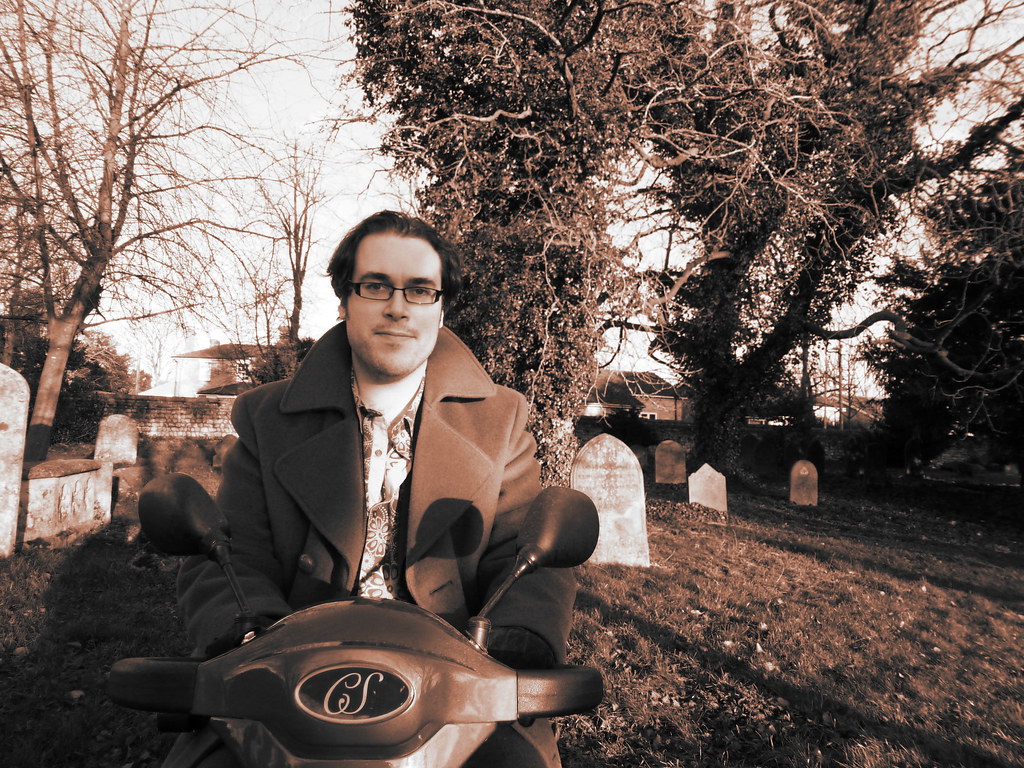
Deb and I have tried to get out of the house a little more this year. This has meant that every few weeks you might see us in convoy along the pavement, her in the lead on her wheelchair while I take up the rear on my scooter. I’d like to think that this was entirely due to her wheelchair being fractionally slower than my scooter and so it making more sense to keep to her pace. I fear, however, that I am actually one of nature’s followers. I prefer to be back a ways, watching others out in front. And Deb has pretty hair - I get to see it blowing about in the wind if I’m behind her.
*Sadly the CS200 had terminal problems and we’re back to being a single scooter household